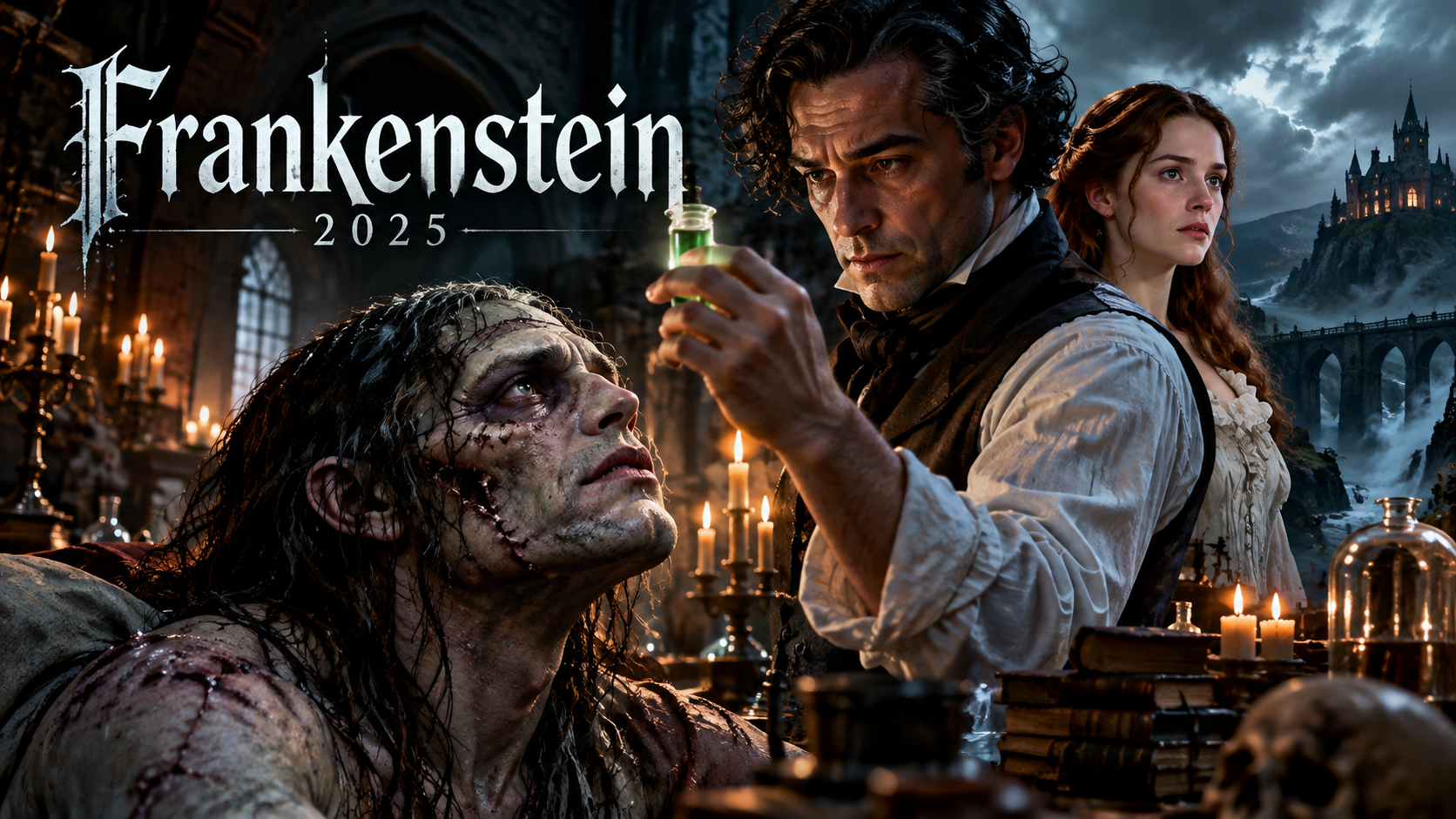
Victor Frankenstein Is Driven by Ambition Rather Than Compassion
Victor Frankenstein is often described as a misunderstood genius. His intelligence allows him to explore scientific possibilities that other people consider impossible. However, intelligence alone does not make someone admirable.
In del Toro’s adaptation, Victor’s scientific ambition is closely connected to his emotional wounds, his difficult relationship with his father, and his desire to prove his own importance.
He is not simply searching for a way to help humanity. He is attempting to accomplish something that will place him beyond ordinary human limitations.
Death becomes an enemy he believes he can defeat through knowledge and determination.
At first, that ambition might seem understandable. Many medical discoveries have emerged because scientists refused to accept what previous generations considered inevitable.
But Victor’s approach is different.
His experiment increasingly becomes a personal obsession. The possibility of creating life matters more to him than the question of what kind of life he is creating.
He spends enormous energy pursuing success, yet gives remarkably little thought to what will happen afterward.
That is the first indication of his selfishness.
Victor wants to achieve something extraordinary, but he has not prepared himself for the ordinary responsibilities of caring for another living being.
Creating Life Does Not Automatically Make Someone a Good Creator
One of the film’s most important ideas is the difference between having the power to create life and having the wisdom to protect it.
Victor succeeds in bringing his experiment to life. The Creature, portrayed by Jacob Elordi, opens his eyes and begins experiencing the world.
For Victor, this should be the moment when his scientific achievement becomes a moral responsibility.
Instead, he responds to his creation with fear, disappointment, and rejection.
The Creature does not arrive with an understanding of language, society, or human morality. He must learn everything through experience.
He is powerful, but he is also vulnerable.
He needs guidance, patience, and someone willing to explain the world around him.
Victor, however, seems more concerned with the consequences of his experiment than with the needs of the being he has created.
His behavior reveals a fundamental failure of empathy.
He has treated life as something to manufacture rather than something to nurture.
The film raises an uncomfortable question: if someone deliberately brings a living being into existence, can they simply abandon that being because the result is not what they expected?
Victor’s actions suggest that his desire to become a creator was never accompanied by a genuine willingness to become a caretaker.
The Creature Is Born Innocent but Treated Like a Monster
Jacob Elordi’s portrayal of the Creature gives the story much of its emotional weight.
Despite his frightening appearance and unusual physical strength, the Creature begins his existence without the cruelty that others eventually associate with him.
He is confused, curious, and desperate to understand the world.
His earliest experiences are shaped by the way other people respond to him.
Instead of receiving affection and guidance, he encounters fear and hostility.
Victor’s rejection is especially damaging because it comes from the person who is most responsible for his existence.
The Creature did not ask to be created.
He did not choose his body, his appearance, or the circumstances of his birth.
Yet he is expected to bear the consequences of decisions made entirely by someone else.
This is what makes the story so tragic.
Victor judges his creation by its appearance and perceived imperfections, while failing to recognize the emotional suffering developing beneath the surface.
The Creature’s later anger does not excuse every action he takes. However, the film encourages viewers to understand how abandonment and repeated rejection contribute to his transformation.
He is not simply born monstrous.
He is pushed toward violence by a world that repeatedly refuses to see him as worthy of compassion.
Victor Wants to Control Life but Cannot Control Himself
Victor’s greatest contradiction is his desire for control.
He believes he can manipulate the boundary between life and death, assembling a new being through scientific experimentation.
Yet he struggles to control his pride, anger, and fear.
His intelligence allows him to solve technical problems, but it does not protect him from emotional immaturity.
When his creation behaves in ways he does not understand, Victor responds as though the Creature is a failed experiment rather than an individual trying to learn.
He expects obedience without offering trust.
He demands results without providing the patience necessary for growth.
These expectations reveal that Victor sees the Creature partly as an extension of his own ambition.
When the Creature no longer reflects the success Victor imagined, he becomes something Victor wants to reject.
The film uses this relationship to explore the danger of confusing authority with responsibility.
Having power over another being does not mean that every decision made with that power is justified.
Sometimes, the person who believes they are most qualified to lead is the one least willing to question their own behavior.
A Father’s Failure Hidden Behind Scientific Genius
Although Victor is a scientist, his relationship with the Creature resembles that of a deeply dysfunctional father and son.
Victor gives the Creature life but refuses to provide the emotional support that would help him understand it.
He expects his creation to become something meaningful without accepting his own role in that development.
This dynamic becomes more significant when viewed alongside Victor’s difficult relationship with his own father.
The film suggests that cruelty and emotional distance can be repeated across generations.
A person who grows up feeling powerless or unloved may eventually seek control over someone more vulnerable.
Victor appears determined to escape the influence of his past, yet reproduces some of its most destructive patterns.
He knows what it feels like to live under the authority of a demanding father, but he fails to recognize when he begins behaving similarly toward the Creature.
That makes his selfishness particularly frustrating.
He has experienced emotional pain himself, but that experience does not automatically make him compassionate.
Instead of breaking the cycle, he continues it.
Elizabeth Recognizes the Humanity Victor Refuses to See
Elizabeth, portrayed by Mia Goth, provides an important contrast to Victor’s perspective.
Where Victor becomes consumed by his expectations and disappointment, Elizabeth approaches the Creature with greater curiosity and sensitivity.
Her presence challenges the assumption that the Creature’s appearance determines his moral worth.
She is willing to look beyond the frightening surface and recognize the possibility of intelligence, feeling, and vulnerability.
This contrast exposes one of Victor’s deepest failures.
The scientist who understands the mechanics of creating life struggles to understand the emotional needs of the life he has created.
Meanwhile, someone without his scientific obsession can recognize the Creature’s humanity more readily.
The film suggests that knowledge and empathy are different qualities.
A person can understand the physical structure of a living body while remaining remarkably insensitive to the suffering within it.
Victor possesses extraordinary knowledge, but his emotional understanding remains limited.
Why the Real Monster May Be Victor Frankenstein
The title Frankenstein is frequently associated with the Creature rather than his creator.
That popular confusion reflects one of the story’s central ironies.
The being who looks monstrous is not necessarily the person most responsible for the tragedy.
Victor’s actions are driven by pride, obsession, and an unwillingness to accept responsibility.
He creates a vulnerable being and then rejects him.
He fears the consequences of his experiment but repeatedly avoids confronting the emotional damage he has caused.
He wants to be remembered for an extraordinary achievement, yet struggles to acknowledge the suffering that achievement produces.
The Creature, by contrast, longs for understanding and acceptance.
His actions eventually become destructive, and the suffering he causes should not be ignored.
But the film asks viewers to consider where the tragedy began.
It began long before the Creature became violent.
It began when Victor treated the creation of life as a personal victory without considering the obligations that followed.
In that sense, the most frightening thing about Victor is not his scientific knowledge.
It is his ability to justify his own cruelty while believing that he is the victim of circumstances beyond his control.
Guillermo del Toro Turns Frankenstein Into an Emotional Tragedy
Guillermo del Toro has long been interested in characters whom society labels as monsters.
His films frequently explore the difference between frightening appearances and genuine moral cruelty.
Frankenstein continues that interest by treating the Creature as more than a symbol of scientific ambition gone wrong.
He becomes a character whose emotional journey is essential to understanding the story.
Del Toro’s gothic visual style supports this interpretation.
The elaborate environments, imposing architecture, and unsettling laboratory imagery create a world where beauty and horror often exist together.
Victor’s experiments may appear extraordinary, but the film does not allow their visual spectacle to erase their moral consequences.
The contrast between Oscar Isaac and Jacob Elordi also strengthens the central conflict.
Isaac presents Victor as an intelligent, charismatic, and increasingly destructive man.
Elordi gives the Creature a combination of physical intensity and emotional vulnerability.
Neither character can be understood entirely through appearance or reputation.
Their relationship becomes a tragedy because both are capable of suffering, yet only one had the choice to begin the experiment.
Frankenstein Is Also a Warning About Scientific Responsibility
Although the story takes place in a gothic world, its questions remain relevant to modern discussions about technology and scientific progress.
Humanity continues to develop increasingly powerful tools in medicine, biotechnology, robotics, and artificial intelligence.
These advances can offer enormous benefits, but they also raise questions about responsibility.
Who should be accountable when an experiment produces unexpected consequences?
How much consideration should be given to the well-being of those affected by new technologies?
And should the ability to accomplish something be treated as sufficient justification for doing it?
Victor Frankenstein represents the danger of pursuing innovation without adequate ethical reflection.
His failure is not that he asks difficult scientific questions.
His failure is that he treats the answers as proof of his greatness while ignoring their human consequences.
The film does not suggest that scientific progress itself is evil.
Instead, it warns that intelligence becomes dangerous when separated from humility and accountability.
The Creature’s Desire for Love Makes the Story More Painful
One of the most heartbreaking aspects of Frankenstein is how little the Creature initially wants from the world.
He does not begin with dreams of power or domination.
He wants to understand his surroundings, communicate with others, and experience some form of companionship.
These desires are remarkably ordinary.
That simplicity makes his rejection more painful.
Victor has accomplished something that should inspire wonder, yet he cannot offer the basic kindness his creation needs.
The Creature’s appearance becomes an obstacle that others cannot see beyond.
His loneliness grows as he realizes that people fear him before they understand him.
The film encourages viewers to consider how much cruelty can emerge from the repeated denial of belonging.
It does not claim that suffering makes every harmful action acceptable.
Instead, it asks whether the tragedy might have been avoided if the Creature had received compassion before his anger took hold.
Why Victor Frankenstein’s Selfishness Is the Film’s Greatest Horror
Frankenstein contains the familiar elements of gothic horror: unnatural experiments, disturbing bodies, death, and the terrifying consequences of forbidden ambition.
Yet its most unsettling idea is psychological rather than supernatural.
Victor’s selfishness is frightening because it is recognizable.
People do not need extraordinary scientific abilities to abandon responsibilities, blame others for their mistakes, or place personal ambition above the well-being of those around them.
Victor simply carries those familiar human weaknesses to an extreme.
He possesses the ability to create life but lacks the emotional maturity to care for it.
He demands recognition for his accomplishments while resisting accountability for their consequences.
He wants control without sacrifice.
That combination makes him a deeply tragic character.
His downfall is not caused by a lack of intelligence.
It is caused by the qualities he refuses to develop: humility, empathy, and responsibility.
Final Thoughts: The Doctor Who Created Life but Failed to Understand It
Frankenstein (2025) is ultimately more than a horror story about a scientist who creates a monster.
It is a story about a man who becomes so obsessed with proving his greatness that he forgets the value of the life standing in front of him.
Victor Frankenstein wants to defeat death, challenge nature, and accomplish something no ordinary person has achieved.
But when his creation opens its eyes, Victor discovers that creating life is far easier than accepting responsibility for it.
The Creature’s tragedy begins with that rejection.
His frightening appearance may make him seem like the monster, but Victor’s pride and emotional cruelty reveal a different kind of horror.
Guillermo del Toro’s adaptation makes this contradiction the emotional foundation of the story.
Oscar Isaac’s Victor is brilliant but deeply selfish, while Jacob Elordi’s Creature reminds viewers that being feared is not the same as being evil.
Both characters make choices that carry painful consequences, but the moral responsibility is not equally shared.
Victor chose to create life. The Creature never chose to be born.
And perhaps that is the most important lesson of Frankenstein: the true measure of a creator is not what they are capable of making, but how they treat what they have brought into the world.




0 Comments
Share your perspective on this story. Keep the conversation thoughtful and respectful.