Those disagreements are usually minor. They may create frustration, but they rarely become matters of life and death.
However, what happens when a familiar neighborhood conflict continues for months without being resolved?
What happens when repeated complaints gradually turn into harassment, hostility, and fear?
And what responsibility do authorities have when warning signs appear long before an act of violence?
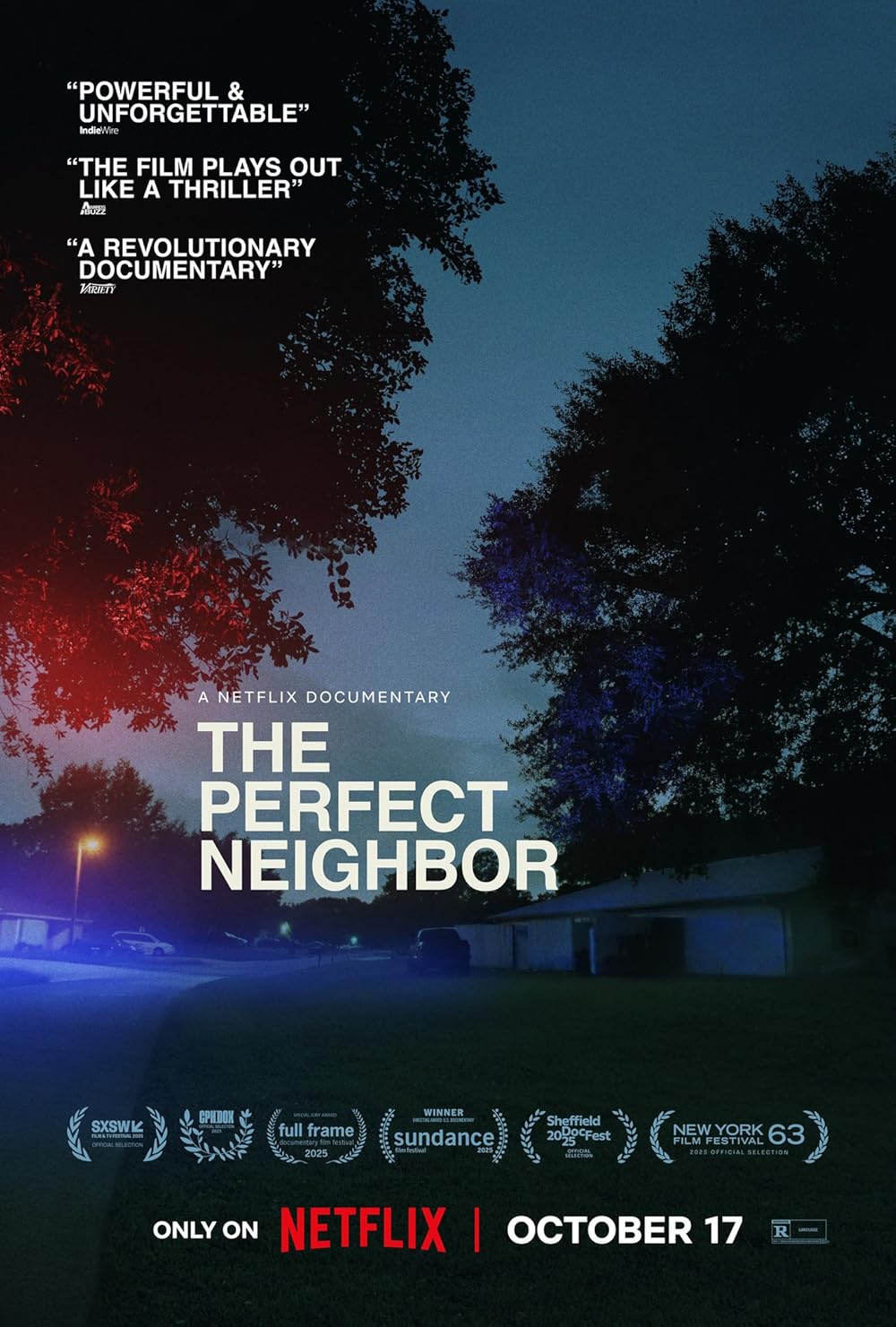
The Perfect Neighbor (2025), directed by Geeta Gandbhir, examines these questions through the real-life killing of Ajike “AJ” Owens, a 35-year-old mother of four in Ocala, Florida.
The documentary reconstructs the events leading to her death through police body-camera recordings, emergency calls, surveillance footage, and investigative material.
Rather than relying on dramatic reenactments, the film allows viewers to observe a neighborhood conflict as it developed through repeated encounters with law enforcement.
The result is a disturbing portrait of a tragedy that did not emerge without warning.
Its most unsettling quality is not simply the violence at the center of the story.
It is the growing realization that the people involved had been living with escalating tension for a considerable period before someone was killed.
What Is The Perfect Neighbor About?
The documentary takes place in a residential community in Ocala, Florida.
Families live close together, and children regularly gather outdoors to play.
For many residents, these activities are ordinary parts of neighborhood life.
However, one resident, Susan Lorincz, repeatedly complains about the children playing near her home.
Her objections lead to frequent calls to the police.
Officers respond to the neighborhood on numerous occasions, speaking with Lorincz, parents, children, and other residents.
Over time, the situation becomes increasingly hostile.
The conflict involves accusations of harassment, aggressive language, and disagreements over the children’s presence in shared outdoor spaces.
Ajike Owens, whose children are among those affected, becomes involved in the dispute.
On June 2, 2023, the conflict reaches a devastating conclusion.
Lorincz fires a gun through her closed front door, fatally striking Owens.
The documentary examines how the neighborhood reached that moment and why repeated opportunities to address the escalating hostility did not prevent the tragedy.
Ajike Owens: The Mother at the Center of the Tragedy
Ajike Owens was a mother of four whose life extended far beyond the circumstances of her death.
Known to family and friends as AJ, she was an important part of a close-knit community.
Her children were central to her daily life, and her relationships with other families reflected the supportive environment that existed within the neighborhood.
One of the documentary’s most important achievements is its effort to preserve that human context.
True-crime stories sometimes reduce victims to the events that ended their lives.
Their names become associated primarily with police reports, legal proceedings, and headlines.
But a person’s identity cannot be adequately understood through the circumstances of their death alone.
Owens was a parent, a neighbor, a friend, and a person whose absence permanently changed the lives of those around her.
The film’s footage of ordinary neighborhood interactions helps viewers understand the community that existed before the shooting.
That context makes the eventual violence more painful.
It reminds audiences that the tragedy did not occur in an abstract crime scene.
It occurred in a place where families had built their everyday lives.
Susan Lorincz and the Escalation of a Neighborhood Conflict
Susan Lorincz was a white resident whose repeated complaints about neighborhood children became a central source of tension.
She frequently contacted law enforcement to report behavior she considered threatening or disruptive.
However, the documentary reveals that other residents and responding officers often interpreted the situation differently.
What Lorincz described as serious misconduct sometimes appeared to others as ordinary childhood activity.
This difference in perception is important.
Neighborhood disagreements often begin because individuals interpret the same behavior in different ways.
One resident may consider children playing outside a normal part of community life.
Another may interpret the same activity as an invasion of personal space.
But disagreement alone does not explain the severity of what happened in Ocala.
The documentary also presents evidence of sustained hostility, racialized language, and behavior that caused fear and distress among residents.
Over time, the conflict became more than a dispute over noise.
It developed into a pattern of antagonism that repeatedly required police attention.
Understanding that pattern is essential to understanding the final act of violence.
Why the Documentary Uses Police Bodycam Footage
One of the most distinctive features of The Perfect Neighbor is its storytelling method.
Geeta Gandbhir constructs the documentary almost entirely from footage that already existed before the film was made.
Police body-camera recordings provide much of the visual material.
Additional evidence includes emergency calls, surveillance footage, and recorded investigative interviews.
This approach creates an unusual sense of immediacy.
Viewers do not simply hear a narrator describe how the conflict developed.
They watch officers arrive at the neighborhood.
They hear residents explain their concerns.
They observe the children’s interactions with police.
And they witness the gradual accumulation of complaints and frustration.
The footage gives the documentary a distinctive perspective because it was originally recorded for law-enforcement purposes rather than cinematic storytelling.
Nevertheless, the finished film remains a carefully edited work.
The director and editor determine which recordings appear, how they are arranged, and how viewers experience the passage of time.
The documentary’s power therefore comes from both the authenticity of its source material and the deliberate construction of its narrative.
The Neighborhood Before the Shooting
One of the film’s most affecting elements is its portrayal of the neighborhood before the tragedy.
The community appears active and interconnected.
Children gather outdoors, while parents maintain relationships with one another.
Police officers responding to complaints encounter residents who generally seem interested in maintaining a peaceful environment.
These scenes are important because they establish what was eventually lost.
The film does not present the neighborhood simply as a location where a crime occurred.
It presents the community as a social environment with routines, relationships, and a sense of belonging.
That sense of ordinary life makes the repeated police visits increasingly unsettling.
What begins as a series of apparently manageable complaints gradually becomes a persistent disruption.
Families must repeatedly explain their activities.
Children become familiar with police attention.
And residents begin adapting their behavior around one person’s hostility.
The film asks viewers to consider how much disruption a community can endure before the situation should be treated as a serious warning.
When Ordinary Childhood Becomes a Source of Suspicion
The children in The Perfect Neighbor are not merely background figures.
Their presence is central to the conflict.
They play outside, gather with friends, and occupy spaces that are part of their everyday environment.
However, their activities repeatedly become subjects of police complaints.
This creates an important social question.
Who gets to feel comfortable in a neighborhood?
And whose ordinary behavior is interpreted as threatening?
In the film, many of the children involved are Black, while Lorincz is white.
That racial difference matters because the documentary presents evidence of prejudice and racialized hostility within the conflict.
It would be inaccurate to assume that every neighborhood disagreement involving people of different races is automatically motivated by racism.
But it would be equally misleading to ignore racial hostility when the available evidence makes it relevant.
The film encourages viewers to examine how prejudice can influence the interpretation of ordinary behavior.
Children playing outdoors may be seen as harmless by one observer and as a threatening presence by another.
When those interpretations influence repeated calls to law enforcement, their consequences extend beyond personal opinion.
Police Were Called Repeatedly, but the Conflict Continued
Perhaps the documentary’s most disturbing feature is the number of opportunities that existed before the fatal shooting.
Police officers were not encountering the neighborhood for the first time on June 2, 2023.
They had responded to earlier complaints and had become familiar with the ongoing dispute.
Those encounters form the foundation of the film.
In several recordings, officers attempt to manage the situation through conversations and informal guidance.
They speak with residents, assess complaints, and try to prevent further confrontation.
But the hostility continues.
This raises a difficult question about the limits of routine police responses.
When does a repeated neighborhood complaint become evidence of a potentially dangerous pattern?
Law enforcement must operate within legal constraints.
Officers cannot automatically arrest someone simply because neighbors describe that person as difficult or unpleasant.
However, repeated allegations of threats, harassment, and escalating aggression may require more than temporary conflict management.
The documentary invites viewers to consider whether the situation was being treated as a collection of separate incidents rather than as a developing pattern.
Why Repeated Warnings Do Not Always Prevent Violence
It is tempting to assume that frequent police involvement should make a neighborhood safer.
But repeated intervention does not automatically resolve the underlying cause of a conflict.
Sometimes it merely interrupts the latest confrontation.
Residents may temporarily separate, complaints may be documented, and officers may leave after determining that no immediate arrest is justified.
Yet the hostility can continue once the police depart.
The Perfect Neighbor illustrates this problem with disturbing clarity.
The same community experiences repeated disruptions, while the underlying relationships become increasingly hostile.
From a prevention perspective, the central question is not whether officers responded to individual calls.
It is whether the responses meaningfully reduced the risk of future harm.
That distinction matters because public safety cannot be measured only by the number of incidents handled.
It must also consider whether foreseeable dangers are recognized and addressed before they become irreversible.
June 2, 2023: The Day the Conflict Became Fatal
On June 2, 2023, the long-running dispute reaches its tragic conclusion.
After her children report another confrontation involving Lorincz, Ajike Owens goes to her neighbor’s home.
Owens approaches the front door to confront Lorincz about what happened.
Lorincz remains inside the residence.
She fires a handgun through the closed door.
The bullet strikes Owens, causing fatal injuries.
The shooting transforms a neighborhood dispute into a homicide investigation.
For the people living nearby, the consequences are immediate and devastating.
Children who had previously been at the center of complaints are suddenly confronting the death of a parent.
Neighbors who had witnessed months of tension now face a tragedy that cannot be undone.
The documentary does not show footage of the exact moment the gun is fired.
Instead, it reconstructs the event through available recordings and documents the emergency response and aftermath.
That decision avoids turning the fatal shot itself into a spectacle.
The emotional weight comes from the people affected by the violence.
The Emotional Impact of the Police Emergency Footage
After the shooting, the documentary’s atmosphere changes dramatically.
The earlier recordings show a community dealing with repeated frustration.
The emergency footage reveals the consequences of a conflict that has become fatal.
Officers and emergency responders arrive as residents struggle to understand what has happened.
The footage captures confusion, fear, and grief.
These moments are difficult to watch because they are not performances created for a film.
They document real people responding to an unexpected tragedy.
For viewers, this creates an ethical responsibility.
The images should not be treated merely as dramatic entertainment.
They are records of an event that permanently affected a family and community.
The film’s effectiveness depends partly on its ability to preserve the seriousness of those moments without exploiting them.
Florida’s Stand Your Ground Law and the Self-Defense Claim
One of the central legal issues in The Perfect Neighbor is Florida’s Stand Your Ground framework.
In general terms, Florida law can remove the duty to retreat before using force in qualifying circumstances.
However, the absence of a duty to retreat does not mean that deadly force is automatically lawful whenever someone feels afraid.
Legal justification depends on specific statutory requirements, including the circumstances surrounding an imminent threat and the reasonableness of the belief that deadly force is necessary.
After shooting Owens, Lorincz claimed that she acted in self-defense.
Her explanation became a major part of the subsequent investigation.
The documentary examines how the claim was evaluated and why the circumstances raised serious questions about whether the shooting was legally justified.
Owens was outside the home when Lorincz fired through the closed door.
The physical separation between the two women became an important element in assessing the claim of immediate danger.
The case demonstrates why self-defense law requires careful examination of evidence rather than accepting a person’s stated fear as sufficient proof.
Fear, Prejudice, and the Meaning of a Threat
Fear is a complicated human response.
It can protect people from genuine danger.
But fear can also be influenced by assumptions, stereotypes, and previous experiences.
Two people observing the same situation may interpret it very differently.
One may see ordinary behavior.
Another may perceive a threat.
When that perception influences the use of deadly force, the consequences can be catastrophic.
The Perfect Neighbor raises questions about the relationship between subjective fear and objective danger.
Feeling threatened does not necessarily establish that a threat was imminent or that lethal force was justified.
This distinction is especially important in cases involving racial prejudice.
If stereotypes influence who is perceived as dangerous, claims of fear can become entangled with broader social inequalities.
The film uses the circumstances of Owens’s death to explore how those assumptions can have deadly consequences.
Racism Is Not Always Expressed Through a Single Dramatic Incident
Discrimination is sometimes imagined as one unmistakable act.
But prejudice can also appear through repeated behavior.
It may influence who receives the benefit of the doubt, whose complaints are taken seriously, and whose presence is considered unwelcome.
In The Perfect Neighbor, the accumulation of incidents is essential.
The film documents a pattern of conflict rather than relying on one isolated confrontation.
That pattern allows viewers to examine how hostility develops over time.
The documentary does not require every action to have the same motive.
Instead, it presents a series of interactions in which racialized language and unequal perceptions of neighborhood behavior become impossible to ignore.
The broader implication is troubling.
A community can experience discrimination not only through formal rules but also through repeated informal attempts to control who belongs in shared spaces.
The Documentary’s Editing Creates a Sense of Dread
Geeta Gandbhir’s storytelling relies heavily on the arrangement of existing footage.
The recordings were not originally created to form a feature-length narrative.
They were collected across different incidents, locations, and points in time.
Turning that material into a coherent documentary required careful selection and sequencing.
Editor Viridiana Lieberman’s work is particularly important to the film’s emotional effect.
The audience gradually becomes familiar with the neighborhood, the residents, and the repeated complaints.
Each new police visit adds another layer of tension.
Because the eventual tragedy is known, ordinary scenes acquire an unsettling quality.
A casual conversation may seem harmless in isolation.
Within the larger sequence, it becomes another reminder that the conflict is continuing.
The editing creates suspense without relying on fictional twists.
The fear comes from watching real events move toward a known outcome.
Why the Film Feels Like a Horror Story Without Being Fiction
The Perfect Neighbor contains no supernatural monster, fictional killer, or elaborate horror premise.
Yet it can be more disturbing than many conventional horror films.
Its tension comes from ordinary surroundings.
The streets look familiar.
The houses resemble countless suburban homes.
The children are engaged in everyday activities.
Nothing about the setting initially suggests an extraordinary crime.
That familiarity makes the violence more unsettling.
The film demonstrates how danger can emerge within spaces people associate with safety.
It also creates dread through repetition.
Viewers watch the conflict continue and recognize that each unresolved encounter may bring the community closer to tragedy.
The result is a form of documentary suspense grounded in real consequences rather than imagined threats.
Why the Title The Perfect Neighbor Is So Disturbing
The title initially sounds reassuring.
A perfect neighbor might be someone who respects boundaries, communicates openly, and contributes to a peaceful community.
But the film uses that expectation ironically.
During the documented conflict, Lorincz presents herself as someone whose concerns deserve recognition.
She also describes herself in terms that contrast sharply with how other residents experience her behavior.
The title therefore invites viewers to question the difference between self-image and conduct.
People often believe they are reasonable even when their actions cause distress to others.
They may interpret themselves as victims of circumstances while overlooking the consequences of their own behavior.
In this case, the gap between personal perception and documented conduct becomes central to understanding the conflict.
The film’s title is not an endorsement of Lorincz’s behavior.
It is a challenge to the assumptions people make about themselves and their place within a community.
Can Bodycam Footage Tell the Whole Truth?
Police body-camera footage can provide valuable evidence.
It captures conversations, physical surroundings, and actions that might otherwise be disputed.
But a recording is not a complete account of reality.
The camera shows events from a particular position.
It may begin recording after an important interaction has already occurred.
It may capture someone’s reaction without showing everything that caused it.
And a documentary can include only a selection of the available material.
These limitations do not make the footage unreliable.
They mean it must be interpreted carefully.
The Perfect Neighbor uses numerous recordings to build a broader understanding of the conflict.
By placing different encounters alongside one another, it reveals patterns that may be difficult to recognize from any single police report.
Its achievement is not that the camera reveals everything.
It is that the accumulated footage allows viewers to understand how a pattern of hostility developed over time.
What the Film Reveals About Community Responsibility
Neighborhood safety depends on more than individual property rights.
It also depends on relationships between people who share public and residential spaces.
Residents do not need to agree about every issue.
Disagreements over noise, parking, children, and boundaries are inevitable.
But a functioning community requires ways to manage those disagreements without intimidation or violence.
The Perfect Neighbor reveals the importance of recognizing when a conflict has moved beyond ordinary frustration.
Repeated threats, harassment, and escalating hostility should not be treated as inevitable features of neighborhood life.
They are warning signs that deserve careful attention.
The documentary also shows how one person’s behavior can affect an entire community.
Children may change where they play.
Parents may become anxious about routine activities.
Neighbors may feel compelled to intervene in disputes they did not create.
Over time, the atmosphere of a neighborhood can change dramatically.
What Happened to Susan Lorincz After the Shooting?
Following the death of Ajike Owens, Susan Lorincz was investigated and arrested.
She was charged in connection with the fatal shooting.
Her claim that she acted in self-defense became part of the legal proceedings.
In August 2024, a jury convicted Lorincz of manslaughter with a firearm.
She was subsequently sentenced to 25 years in prison.
The verdict established criminal responsibility for Owens’s death.
However, the legal outcome could not reverse the loss experienced by her family.
The case demonstrates the difference between accountability and restoration.
A criminal conviction can impose punishment and formally recognize wrongdoing.
It cannot return a parent to her children or erase the trauma experienced by a community.
Why the Film Refuses to Let the Victim Become a Footnote
True-crime documentaries often devote substantial attention to the person responsible for a crime.
Viewers may learn about the offender’s behavior, motivations, statements, and legal defense.
That information can be necessary to understand what happened.
But it also creates a risk.
The victim may become less visible than the person who caused the harm.
The Perfect Neighbor works against that imbalance by emphasizing the neighborhood and the family affected by Owens’s death.
The footage of children playing, parents talking, and neighbors interacting provides an emotional foundation for the story.
Those scenes show the life that existed before the shooting.
They also reveal what the community lost.
Owens’s legacy is not limited to the criminal case.
It includes her relationships, her children, and the people who continue to remember her.
Geeta Gandbhir’s Personal Connection to the Story
For director Geeta Gandbhir, The Perfect Neighbor is not simply a professional investigation into a widely reported crime.
She has described the documentary as a deeply personal project connected to the grief surrounding Ajike Owens’s death.
Her intention was to honor Owens and help audiences understand the circumstances that led to the tragedy.
This personal investment shapes the film’s perspective.
Rather than presenting the case as an abstract debate, the documentary emphasizes the experiences of the affected community.
Its use of police footage also serves an important purpose.
Recordings typically associated with criminal investigations become a way to preserve the voices and everyday experiences of people who might otherwise appear only briefly in news coverage.
That approach gives the film both investigative and memorial significance.
Why The Perfect Neighbor Matters Beyond Florida
Although the documentary focuses on one neighborhood in Ocala, its themes extend far beyond that location.
Communities everywhere face disagreements about shared spaces, acceptable behavior, and personal boundaries.
Those conflicts become especially dangerous when prejudice, intimidation, and access to lethal weapons are involved.
The film also raises questions about public institutions.
When authorities respond repeatedly to a developing conflict, how should they recognize the possibility of escalation?
What forms of intervention are available before a serious crime occurs?
And how can legal systems distinguish legitimate self-defense from violence justified through exaggerated or unreasonable fear?
These questions do not have simple answers.
But the documentary demonstrates why they deserve sustained public attention.
Its relevance lies in showing how an apparently local dispute can reveal much larger social and institutional problems.
The Strengths and Limitations of the Documentary
The Perfect Neighbor is particularly effective because it avoids excessive explanation.
Its recordings allow viewers to observe the conflict and recognize recurring patterns.
The absence of dramatic reenactments helps maintain a sense of authenticity.
The editing also creates a strong emotional progression, moving from ordinary neighborhood interactions toward increasingly serious confrontations.
However, the documentary’s method has limitations.
Because the film relies heavily on footage recorded during police encounters, viewers see residents primarily when law enforcement is present.
That perspective cannot fully capture every aspect of their private lives.
Ajike Owens herself appears less frequently than the significance of her story might lead audiences to expect.
As a result, the film’s understanding of her life depends partly on the community context and the testimony of those who knew her.
The documentary also presents a clear moral perspective on the consequences of the conflict.
Viewers seeking a broader legal examination of self-defense statutes may need additional sources beyond the film.
These limitations do not diminish the documentary’s importance.
They clarify what its storytelling approach is designed to accomplish.
Frequently Asked Questions About The Perfect Neighbor (2025)
Is The Perfect Neighbor based on a true story?
Yes. The documentary examines the real killing of Ajike “AJ” Owens in Ocala, Florida, on June 2, 2023.
Who directed The Perfect Neighbor?
The film was directed by Geeta Gandbhir, an award-winning documentary filmmaker.
Who was Ajike Owens?
Ajike Owens was a 35-year-old mother of four who was fatally shot by her neighbor, Susan Lorincz, in June 2023.
Who is Susan Lorincz?
Susan Lorincz is the Florida woman convicted of manslaughter with a firearm for shooting Ajike Owens through her closed front door.
What happened to Susan Lorincz?
Lorincz was convicted in August 2024 and sentenced to 25 years in prison.
Does the documentary show the actual shooting?
No. The film does not show the precise moment the gun is fired. It reconstructs the events through available recordings and documents the emergency response and aftermath.
What is Florida’s Stand Your Ground law?
Florida’s Stand Your Ground framework generally removes the duty to retreat in certain circumstances, but deadly force must still meet legal requirements. The law does not automatically justify shooting someone because of a subjective feeling of fear.
When was The Perfect Neighbor released?
The documentary premiered at the Sundance Film Festival in January 2025. It received a limited theatrical release on October 10, 2025, and began streaming on Netflix on October 17, 2025.
Where can I watch The Perfect Neighbor?
The Perfect Neighbor is available on Netflix, subject to regional availability.
What is the main message of The Perfect Neighbor?
The documentary examines how repeated hostility, racial prejudice, ineffective conflict management, and access to deadly force can turn an ongoing neighborhood dispute into an irreversible tragedy.
Final Thoughts: The Warning Signs Were There Long Before the Tragedy
The Perfect Neighbor (2025) is a devastating documentary about the consequences of allowing hostility to grow until it becomes impossible to ignore.
Its power comes from the ordinary nature of its setting.
The tragedy unfolds in a neighborhood where families live, children play, and residents expect to feel safe.
Nothing about the environment initially suggests that it will become the location of a fatal shooting.
Yet the documentary reveals a prolonged pattern of conflict, repeated police involvement, and growing tension.
By arranging real recordings into a carefully constructed narrative, Geeta Gandbhir allows viewers to recognize how the warning signs accumulated.
The film raises serious questions about racial prejudice, the limits of law enforcement, and the interpretation of self-defense laws.
But its emotional center remains the loss of Ajike Owens.
Her death left four children without their mother and permanently changed the community around them.
The subsequent conviction of Susan Lorincz established criminal accountability, but it could not repair that loss.
Ultimately, the documentary asks audiences to consider what it means to recognize danger before tragedy occurs.
Repeated complaints and escalating hostility should not automatically be dismissed as ordinary neighborhood drama.
Sometimes they reveal a situation that requires serious intervention.
The Perfect Neighbor is therefore more than a record of one criminal case.
It is a reminder that public safety depends not only on responding after violence occurs, but also on understanding the warning signs that appear beforehand.
A peaceful neighborhood is not defined by the absence of disagreement. It is defined by whether its residents can resolve conflict without turning fear and hostility into violence.


0 Comments
Share your perspective on this story. Keep the conversation thoughtful and respectful.