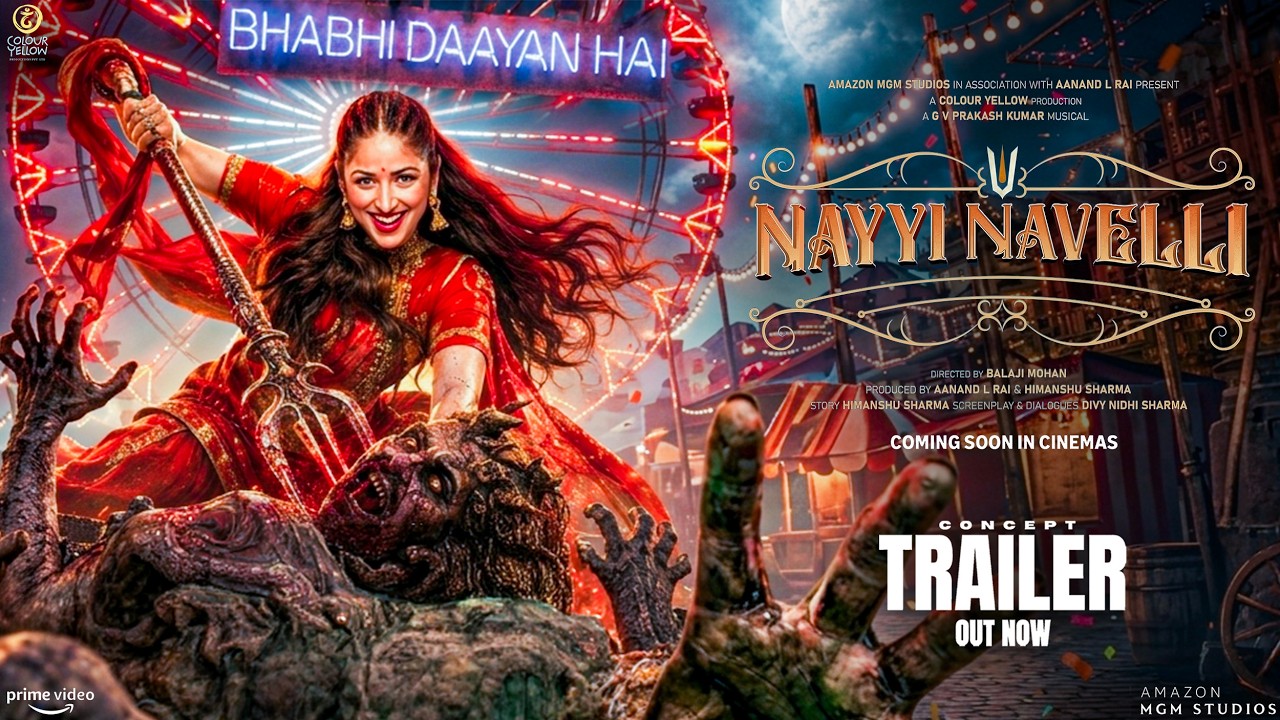
Released theatrically on October 16, 2026, the film combines domestic comedy, supernatural mystery, and elements inspired by Hindu mythology.
Its story begins with an apparently familiar situation: a newly married woman enters a chaotic household and gradually transforms its atmosphere.
At first, her presence seems almost miraculous.
The family becomes more organized, relationships begin to improve, and the household experiences a sense of harmony that previously appeared impossible.
But that transformation creates suspicion rather than universal gratitude.
Mohini’s sister-in-law begins questioning whether the new bride is truly an ordinary woman.
Could her extraordinary influence be connected to something supernatural?
And if Mohini is hiding another identity, what might that mean for the people living around her?
From this premise, Nayyi Navelli moves into a story involving supernatural forces, mythological references, and family relationships shaped by fear and uncertainty.
The film’s ambition is considerable. It attempts to combine the familiar tensions of an Indian family comedy with the unsettling possibilities of supernatural horror and a mythological conflict extending across different ages.
Whether those elements form a satisfying whole is another question.
What Is Nayyi Navelli About?
The story takes place in Meerut, where a household struggling with disorder and internal tensions welcomes a new bride named Mohini.
Played by Yami Gautam, Mohini initially appears to possess qualities that make her an ideal addition to the family.
She is capable, composed, and seemingly able to resolve problems that other members of the household have struggled to manage.
Her arrival brings noticeable changes.
Domestic routines become more manageable, and the atmosphere inside the home begins to improve.
For some family members, these developments seem like reasons to celebrate.
However, Mohini’s sister-in-law grows increasingly suspicious.
Rather than accepting the transformation as the result of Mohini’s personality or abilities, she begins to consider a more disturbing explanation.
She suspects that Mohini may be a daayan, a supernatural figure associated with witchcraft in South Asian folklore.
As suspicion grows, the narrative expands beyond an ordinary domestic mystery.
The film introduces supernatural forces and mythological connections involving the Ramayana, including elements associated with Ravana.
What begins as a story about a newly married woman entering a complicated family becomes a confrontation between domestic expectations and forces that may reach far beyond the household.
Mohini: The Perfect Bride Who Becomes the Center of Suspicion
Mohini is the most important character in Nayyi Navelli because the entire story depends on how others interpret her presence.
Her introduction follows a recognizable social expectation.
A new bride enters a household and is expected to adapt to its routines, respect its traditions, and establish relationships with her husband’s family.
But Mohini appears to do more than simply adapt.
She changes the environment around her.
Problems that once seemed difficult become manageable, and the household begins functioning more smoothly.
On the surface, this makes her an ideal family member.
Yet the same qualities that make her admirable also make her suspicious.
Her influence seems almost too effective.
This creates an interesting contradiction.
The family appears to want someone capable of improving its circumstances, but extraordinary competence becomes unsettling when it cannot be easily explained.
Mohini’s character therefore occupies an unusual position between domestic idealization and supernatural fear.
She represents both the promise of harmony and the possibility of hidden danger.
Yami Gautam and the Challenge of Playing an Ambiguous Character
Yami Gautam’s role as Mohini requires the character to operate on more than one level.
She must initially appear believable as a newly married woman entering a family environment.
At the same time, the story depends on the possibility that there is something unusual about her.
This creates a performance challenge because the character’s mystery should not disappear too quickly.
If Mohini appears obviously supernatural from the beginning, the suspicion surrounding her loses much of its dramatic value.
But if she seems entirely ordinary throughout the film, the transition toward mythological horror may feel abrupt.
The role therefore depends on maintaining uncertainty.
Small changes in expression, behavior, and emotional tone can become important tools for suggesting that Mohini may not be exactly what she appears.
Yami Gautam’s presence also gives the film a recognizable central performer around whom its competing genres can develop.
The character’s effectiveness ultimately depends on whether the screenplay gives her enough emotional depth beyond the mystery of her identity.
The Sister-in-Law’s Suspicion Drives the Mystery
While Mohini occupies the center of the story, the suspicion directed toward her provides much of the narrative momentum.
Her sister-in-law begins questioning the unusual changes taking place within the household.
This suspicion creates a conflict between two interpretations of the same events.
One interpretation sees Mohini as a positive influence.
The other sees her as a potential threat.
That disagreement is particularly useful in a horror comedy because it can generate both tension and humor.
A character who believes something supernatural is happening may appear unreasonable to people who see no immediate danger.
Attempts to prove the suspicion can lead to misunderstandings, awkward confrontations, and increasingly elaborate explanations.
However, the humor depends on the audience understanding why the character feels suspicious.
Without a convincing progression of evidence, the conflict risks becoming repetitive.
The strongest version of this premise would allow viewers to move between skepticism and concern rather than accepting one interpretation immediately.
Why Meerut Is an Interesting Setting for the Story
Setting the film in Meerut gives Nayyi Navelli a recognizable North Indian social environment.
The household is not simply a location where supernatural events occur.
It represents a network of relationships, expectations, and family responsibilities.
In stories involving newly married women, the domestic setting can carry particular significance.
A bride may be expected to establish her place within an existing family structure while negotiating relationships with relatives who have different personalities and expectations.
These pressures provide a natural foundation for comedy and conflict.
They also create opportunities for horror.
When suspicion emerges inside a family home, the characters cannot always escape one another.
They continue sharing rooms, routines, and responsibilities even as trust begins to deteriorate.
That proximity can make ordinary domestic spaces feel increasingly uncomfortable.
The supernatural premise becomes more effective when it disrupts an environment that initially feels familiar.
Horror and Comedy: Two Genres That Depend on Timing
Horror and comedy may appear to be opposites, but they share an important characteristic.
Both depend heavily on timing.
A frightening moment often works because the audience anticipates danger before it arrives.
A joke frequently works because the audience expects one outcome and receives another.
Horror comedies exploit that relationship by shifting between fear and surprise.
Nayyi Navelli attempts to apply this approach to a family setting.
Suspicion surrounding Mohini can produce unsettling situations, while the reactions of other household members create opportunities for humor.
However, combining the genres requires control.
If comedy interrupts every frightening scene, the supernatural threat may lose credibility.
If the horror becomes too serious, the humor may feel disconnected from the rest of the film.
The challenge is to make both elements contribute to the same story.
The film’s mixed critical reception suggests that this balance has been one of its more contested qualities.
The Daayan Figure and Its Place in Indian Folklore
The suspicion that Mohini may be a daayan connects Nayyi Navelli to a long tradition of supernatural storytelling in South Asia.
The daayan is commonly associated with witch-like figures in regional folklore, although specific characteristics vary across traditions.
Such figures often appear in stories involving fear, hidden identities, unusual powers, and threats to family or community life.
In popular cinema, these associations can provide audiences with a familiar supernatural framework.
A character accused of being a daayan may immediately become the subject of fear, suspicion, and exaggerated assumptions.
But the concept also carries social implications.
Historically, accusations of witchcraft have sometimes been used to stigmatize women, particularly those whose behavior or circumstances challenge community expectations.
This makes the premise potentially more complex than a simple monster mystery.
When a woman is accused of possessing supernatural powers because she behaves differently from what others expect, the story can also raise questions about prejudice and social control.
Whether Nayyi Navelli fully explores those implications is a separate matter from the potential contained in its premise.
The Perfect Daughter-in-Law as a Social Expectation
One of the film’s most interesting ideas concerns the expectations placed on a newly married woman.
Mohini enters a troubled household and appears capable of making everything better.
That transformation initially makes her desirable within the family.
But it also creates a troubling question.
Why is her competence interpreted as something potentially unnatural?
The premise can be read as a commentary on unrealistic expectations surrounding domestic roles.
A daughter-in-law may be expected to maintain harmony, manage responsibilities, and adapt to family traditions.
Yet a woman who exercises too much influence may also become the subject of suspicion.
Mohini’s situation exaggerates this contradiction through supernatural storytelling.
She appears to fulfill the ideal so completely that others begin questioning whether she can be human.
This is a promising foundation for satire.
The difficulty lies in ensuring that the supernatural elements strengthen the social commentary rather than overwhelming it.
How Ramayana Mythology Enters the Story
Nayyi Navelli expands beyond domestic horror by incorporating mythological references associated with the Ramayana.
The story reportedly connects its supernatural conflict to a mysterious episode linking Treta Yuga and Kalyug.
In Hindu cosmological traditions, these terms refer to different ages within a larger cyclical understanding of time.
Treta Yuga is particularly associated with the events of the Ramayana.
Kalyug, or Kali Yuga, is commonly understood as the present age within that traditional framework.
Connecting the two allows the film to imagine ancient forces influencing contemporary life.
That approach creates opportunities for fantasy, horror, and mythological spectacle.
However, mythology introduces additional storytelling responsibilities.
Audiences need enough information to understand why ancient events matter to the modern characters.
Without a clear connection between the mythological background and the household conflict, the narrative can become difficult to follow.
Ravana and the Expansion Into Mythological Conflict
References to Ravana introduce one of the most recognizable figures associated with the Ramayana.
Ravana is a complex character within the epic tradition, often associated with immense power, knowledge, pride, and his conflict with Rama.
His mythological significance gives filmmakers access to a vast symbolic framework.
But using that framework in a contemporary horror comedy is challenging.
The story must establish how mythological elements relate to its characters rather than simply using familiar names to create spectacle.
In Nayyi Navelli, the reported involvement of Ravana-related mythology expands the conflict beyond suspicion about one newly married woman.
It suggests that the events inside the household may connect to a much larger supernatural struggle.
That expansion can increase the film’s scale.
It can also weaken the intimacy of the original premise if the transition is not handled carefully.
A small family mystery and a mythological confrontation operate at very different dramatic levels.
Connecting them convincingly requires a clear narrative bridge.
Why Mythology Can Make a Horror Comedy More Ambitious
Indian cinema has a long history of drawing inspiration from mythology, folklore, and religious storytelling.
These traditions offer familiar symbols that can be reinterpreted through contemporary genres.
Horror can transform mythological ideas into sources of uncertainty and danger.
Comedy can expose contradictions between ancient beliefs and modern behavior.
Fantasy can connect everyday characters with extraordinary forces.
Nayyi Navelli attempts to bring these possibilities together.
Its central family conflict provides an accessible starting point, while the mythological material introduces larger stakes.
The ambition is understandable.
However, greater scale does not automatically produce a stronger film.
Mythological references are most effective when they deepen the characters’ choices and the consequences of their actions.
If they function mainly as additional plot complications, the story may become crowded rather than meaningful.
Balaji Mohan’s Direction and the Challenge of Genre Control
Balaji Mohan directs Nayyi Navelli from a screenplay credited to Himanshu Sharma and Divy Nidhi Sharma.
The film’s premise requires careful coordination between character comedy, supernatural suspense, and mythological fantasy.
Each element demands a different rhythm.
Family comedy depends on interactions, misunderstandings, and recognizable behavior.
Horror depends on uncertainty, atmosphere, and the possibility of danger.
Mythological fantasy often requires exposition and a broader narrative structure.
Bringing these approaches together is difficult because one can easily interrupt another.
The director must decide when to allow a scene to remain humorous and when to shift toward genuine tension.
He must also ensure that the audience understands the mythology without slowing the film through excessive explanation.
The critical response described in contemporary coverage suggests that the film’s execution has struggled to satisfy all these demands consistently.
A Strong Premise Does Not Guarantee a Coherent Screenplay
Nayyi Navelli begins with a concept that is easy to understand.
A seemingly perfect bride enters a troubled family, and another member of the household begins suspecting that she possesses supernatural powers.
That premise already contains mystery, humor, and social tension.
It does not require a complicated mythology to become interesting.
However, the story reportedly introduces increasingly elaborate supernatural and mythological developments.
This creates a structural risk.
Every additional explanation requires time and attention.
Every new supernatural element must connect meaningfully to what the audience already understands.
If too many concepts arrive before earlier questions have been resolved, the narrative can begin to feel overloaded.
Several critical responses have reportedly identified confusion and excessive narrative complexity as weaknesses.
That criticism points toward a broader filmmaking principle.
A movie can contain many imaginative ideas while still needing a clear emotional and dramatic center.
The Supporting Cast and the Importance of Family Dynamics
Alongside Yami Gautam, the film features performers including Sunita Rajwar, Jacqueline Fernandez, Addinath M. Kothare, and Mita Vashisht.
The supporting ensemble is important because the film’s premise depends on reactions within a shared household and the wider supernatural conflict.
Family comedies become engaging when characters respond differently to the same situation.
Some may be trusting.
Others may be suspicious.
Some may dismiss unusual events as misunderstandings, while others interpret them as evidence of something supernatural.
These contrasting reactions can create humor without requiring every character to behave irrationally.
They can also help maintain suspense.
When different people possess different pieces of information, the audience must decide whose interpretation seems most credible.
For Nayyi Navelli, the effectiveness of its ensemble depends on whether those characters contribute to the central conflict rather than simply adding more incidents to an already complicated plot.
Music by GV Prakash Kumar
The film’s music is credited to GV Prakash Kumar, with lyrics by Vayu.
Music can play a particularly important role in horror comedy.
A tense musical cue may prepare viewers for something frightening.
A sudden change in tone can turn the same moment into a joke.
And a recurring musical theme can help connect domestic scenes with the larger supernatural narrative.
In a film combining family relationships and mythological spectacle, the score also has the potential to establish differences in scale.
Intimate scenes may require a restrained emotional approach.
Supernatural confrontations may call for a more dramatic sound.
The challenge is to maintain a recognizable musical identity across these shifts.
Without a detailed examination of the complete soundtrack, it would be premature to rank the score among the film’s strengths or weaknesses.
Nevertheless, the musical component is an important part of how this kind of genre combination communicates its tone.
Why the Film’s Critical Reception Has Been Divided
According to the critical coverage supplied for this article, Nayyi Navelli received mixed-to-negative reviews following its theatrical release.
Some responses acknowledged the potential of its unusual premise and Yami Gautam’s central performance.
However, critics also questioned the screenplay’s clarity and the film’s ability to balance its competing genres.
The supernatural mythology reportedly becomes increasingly elaborate, while the comedy does not always provide the expected payoff.
These criticisms are connected.
When a story introduces too many ideas, audiences may struggle to understand which conflict matters most.
Humor can become less effective because the setup is unclear.
Horror can become less threatening because the rules of the supernatural world are difficult to follow.
And mythology can lose its emotional significance when it is introduced mainly to expand the scale of the narrative.
The film therefore illustrates the difference between an imaginative concept and a fully controlled execution.
What Nayyi Navelli Appears to Do Well
Despite its reported weaknesses, the film has several qualities that make it interesting to discuss.
Its central premise is distinctive.
Rather than beginning with an isolated haunted location or a conventional ghost encounter, it introduces supernatural uncertainty through the arrival of a new family member.
That allows horror to emerge from ordinary domestic expectations.
The film also attempts to connect social comedy with mythological storytelling.
Its treatment of the ideal bride offers potential commentary on the expectations placed on women within family structures.
And the inclusion of Ramayana-inspired material gives the narrative a cultural framework beyond standard haunted-house conventions.
These ideas are ambitious even if their execution has attracted criticism.
For audiences interested in unusual genre combinations, the film’s willingness to experiment may remain part of its appeal.
Where the Film’s Storytelling Faces Difficulties
The principal weakness identified in the supplied critical coverage is narrative overcrowding.
Nayyi Navelli begins with a domestic mystery but reportedly expands into a complicated mythological conflict.
Such expansion is not inherently problematic.
Many successful genre films begin with a small mystery before revealing a larger supernatural world.
The difficulty emerges when the additional material does not feel sufficiently connected to the original characters.
Audiences may begin following explanations rather than emotional decisions.
The story can also struggle when humor and horror appear to compete for attention.
Comedy requires a degree of clarity so that viewers understand why a situation is amusing.
Horror requires enough consistency for danger to feel meaningful.
If the film repeatedly changes its rules or introduces new mythology, both effects can weaken.
These concerns help explain why an intriguing premise may not have translated into equally enthusiastic critical reviews.
The Film’s Place Within Modern Indian Horror Comedy
Indian horror comedy has become an increasingly visible commercial genre.
Its appeal often comes from combining recognizable social environments with supernatural folklore.
Rather than presenting horror as entirely separate from everyday life, these films place extraordinary events inside familiar communities and relationships.
Nayyi Navelli follows that broad approach while introducing its own emphasis on marriage, household expectations, and Ramayana mythology.
Its story is particularly interested in the disruption caused by a woman whose presence seems almost impossibly beneficial.
That idea distinguishes it from more conventional narratives in which a supernatural presence is immediately associated with destruction.
Here, suspicion begins because things appear to be improving too quickly.
This reversal gives the film an unusual foundation.
Whether audiences find the final result satisfying depends largely on their tolerance for tonal shifts and complicated mythological storytelling.
Frequently Asked Questions About Nayyi Navelli (2026)
What is Nayyi Navelli about?
Nayyi Navelli follows Mohini, a newly married woman who transforms a troubled household in Meerut. Her extraordinary influence leads her sister-in-law to suspect that she may be connected to supernatural forces.
Is Nayyi Navelli a horror movie or a comedy?
It is a Hindi-language horror comedy that combines family humor, supernatural mystery, and mythological fantasy.
Who plays Mohini in Nayyi Navelli?
Yami Gautam plays the central character, Mohini.
Who directed Nayyi Navelli?
The film was directed by Balaji Mohan.
Who wrote Nayyi Navelli?
The screenplay is credited to Himanshu Sharma and Divy Nidhi Sharma.
When was Nayyi Navelli released?
The film was released theatrically on October 16, 2026.
Does Nayyi Navelli involve Ramayana mythology?
Yes. The story incorporates mythological elements associated with the Ramayana, including references to Ravana and the relationship between Treta Yuga and Kalyug.
What does daayan mean?
Daayan is a term associated with witch-like supernatural figures in parts of South Asian folklore. Its specific meanings and characteristics vary across regional traditions.
Who composed the music for Nayyi Navelli?
GV Prakash Kumar is credited with the film’s music, with lyrics by Vayu.
How was Nayyi Navelli received by critics?
The supplied review coverage describes a mixed-to-negative response, with criticism directed at the film’s crowded narrative and inconsistent balance between horror and comedy.
Final Thoughts: An Imaginative Horror Comedy With Too Many Competing Ideas?
Nayyi Navelli (2026) begins with a genuinely intriguing question: what if the perfect new bride were hiding something supernatural?
That premise combines domestic comedy with a mystery capable of generating both humor and fear.
Yami Gautam’s Mohini becomes the center of a household conflict in which extraordinary competence is interpreted as possible evidence of an unnatural identity.
The idea offers opportunities for social satire, particularly concerning the expectations placed on women entering established family structures.
It also allows the story to explore the tension between trust and suspicion.
However, the film does not remain within that relatively simple framework.
Its narrative expands into supernatural mythology involving the Ramayana and Ravana-related elements.
That ambition creates a larger and more elaborate story, but it also introduces challenges of pacing, clarity, and tonal consistency.
The mixed-to-negative critical response suggests that the film has struggled to balance all its ideas successfully.
Still, Nayyi Navelli remains an interesting example of how Indian horror comedy continues experimenting with folklore, domestic relationships, and mythological fantasy.
Its strongest concept is also its simplest.
A household welcomes someone who appears capable of solving every problem, only to discover that perfection itself can become a reason for fear.
Ultimately, Nayyi Navelli demonstrates that an imaginative supernatural premise needs more than mythology and spectacle. It also needs clear characters, controlled storytelling, and a convincing connection between its smallest domestic conflicts and its largest supernatural threats.




0 Comments
Share your perspective on this story. Keep the conversation thoughtful and respectful.